


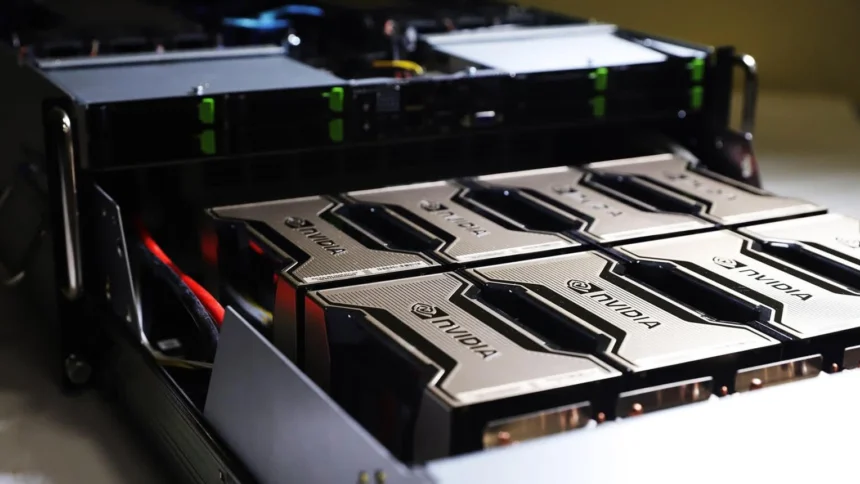
When people talk about artificial intelligence, they usually focus on visible products.
- NVIDIA Was Never Originally Built for AI
- The Discovery That Changed Everything
- CUDA Became NVIDIA’s Secret Weapon
- The AI Boom Turned GPUs Into Digital Oil
- Data Centers Became the New Industrial Factories
- Why Big Tech Depends So Heavily on NVIDIA
- The Energy Problem Nobody Talks About Enough
- Competitors Are Trying to Break NVIDIA’s Dominance
- NVIDIA’s Rise Explains the Future of AI Itself
ChatGPT.
AI image generators.
Autonomous vehicles.
Smart assistants.
Video AI tools.
But behind nearly every major AI system dominating headlines today sits the same invisible foundation:
NVIDIA hardware.
And the company’s rise to power did not happen suddenly.
It was built through a long-term strategy that most of the technology industry underestimated for years.
NVIDIA Was Never Originally Built for AI
In the 1990s and early 2000s, NVIDIA was primarily known inside gaming communities.
The company designed graphics processing units — GPUs — mainly for rendering video games, 3D graphics, and visual computing. Gamers cared deeply about frame rates and graphical performance, but outside the gaming world, GPUs were still considered somewhat niche hardware.
At that time, the technology industry’s biggest opportunities seemed to revolve around:
search engines,
mobile phones,
social media,
and internet platforms.
Very few people believed graphics hardware would eventually become one of the most valuable assets in artificial intelligence.
NVIDIA did.
The Discovery That Changed Everything
Researchers working on machine learning eventually discovered something extremely important:
GPUs were far better than traditional CPUs for handling parallel mathematical operations required in AI training.
A CPU is designed for general-purpose computing.
A GPU is designed to process enormous numbers of calculations simultaneously.
That difference became critical once AI models started growing larger.
Training modern AI systems involves processing billions or even trillions of calculations repeatedly across massive datasets. GPUs dramatically accelerated that process.
Suddenly, hardware originally built for gaming became the engine behind machine learning itself.
And NVIDIA already controlled the ecosystem.
CUDA Became NVIDIA’s Secret Weapon
Most people think NVIDIA’s dominance comes only from powerful chips.
In reality, its biggest advantage may be software.
Years ago, NVIDIA launched CUDA, a developer platform allowing engineers and researchers to use GPUs for scientific and computational workloads beyond graphics rendering.
At first, this seemed highly technical and relatively unimportant to the public.
But over time, CUDA became deeply integrated into:
AI research,
machine learning frameworks,
university programs,
scientific computing,
and enterprise AI systems.
This created a massive ecosystem lock-in effect.
Developers worldwide built tools, workflows, libraries, and infrastructure around NVIDIA hardware. Once that ecosystem matured, switching to competing platforms became difficult even when alternative chips improved.
Technology history repeatedly shows that ecosystems often become more powerful than hardware specifications alone.
The AI Boom Turned GPUs Into Digital Oil
When generative AI exploded globally, demand for AI computing infrastructure surged almost overnight.
Companies everywhere suddenly wanted:
large language models,
AI assistants,
recommendation systems,
automation tools,
and enterprise AI platforms.
All of those systems required enormous computational power.
NVIDIA GPUs became the most sought-after resource in the technology industry.
Cloud providers rushed to buy them.
AI startups competed aggressively for access.
Governments increased semiconductor investments.
Investors realized infrastructure itself was becoming one of the most valuable layers of the AI economy.
At one point, acquiring large numbers of advanced GPUs became so difficult that some companies waited months for delivery capacity.
That level of demand transformed NVIDIA from a semiconductor company into the backbone of modern AI infrastructure.
Data Centers Became the New Industrial Factories
One of the least visible parts of the AI revolution is physical infrastructure.
Modern AI systems depend on giant data centers filled with:
GPU clusters,
networking systems,
cooling infrastructure,
backup power systems,
and advanced semiconductor hardware operating continuously.
Training advanced AI models costs enormous amounts of money because these systems require extraordinary computational resources.
This is why AI is no longer purely a software industry.
It increasingly resembles industrial infrastructure.
And NVIDIA sits directly at the center of it.
Why Big Tech Depends So Heavily on NVIDIA
Companies like Microsoft, Amazon, Google, Meta, and OpenAI all require massive AI infrastructure.
Even though some are developing custom AI chips internally, NVIDIA still dominates much of the ecosystem because:
its hardware performs reliably at scale,
its software ecosystem is mature,
and its infrastructure integrates deeply with modern AI workflows.
This created an unusual situation in technology.
Many companies competing aggressively against one another still depend on the same underlying infrastructure provider.
That level of influence is rare.
The Energy Problem Nobody Talks About Enough
As AI systems become larger, power consumption is increasing rapidly.
AI GPUs consume enormous amounts of electricity.
Large data centers require advanced cooling systems.
Global AI infrastructure expansion is placing pressure on energy systems worldwide.
Some AI-focused data centers now consume energy comparable to small towns.
This is forcing technology companies to rethink:
energy efficiency,
cooling systems,
renewable infrastructure,
and hardware optimization.
The future AI race may depend not only on intelligence, but also on which companies can operate infrastructure sustainably at scale.
Competitors Are Trying to Break NVIDIA’s Dominance
NVIDIA’s success naturally attracted competition.
AMD is expanding aggressively into AI accelerators.
Google built TPUs for internal AI systems.
Amazon developed custom AI chips for AWS.
Microsoft increased semiconductor investments.
Multiple startups are building specialized AI processors.
But replacing NVIDIA is difficult because the company’s strength extends beyond hardware performance alone.
Its real power comes from the ecosystem surrounding the hardware:
software tools,
developer familiarity,
enterprise adoption,
and years of AI optimization.
That kind of advantage takes time to challenge.
NVIDIA’s Rise Explains the Future of AI Itself
The company’s success reveals something important about the future of artificial intelligence:
The most valuable businesses may not always be the apps people interact with directly.
They may be the companies controlling the infrastructure underneath everything else.
Because every AI-generated image, chatbot response, recommendation engine, or intelligent automation system ultimately depends on computational power somewhere behind the scenes.
And right now, much of that power flows through NVIDIA.